ELEGOO 1.75mm Black PETG Filament Review: Who It Fits and Who Should Skip It
As an Amazon Associate we earn from qualifying purchases. Links on this page are affiliate links.
ELEGOO's standard PETG in black is a 1kg spool of 1.75mm filament at ±0.02mm, aimed at sturdy everyday parts: clamps, holders, brackets and replacement printer parts. ELEGOO pitches it as a middle ground between PLA and ABS, with more impact resistance than PLA, little warping or shrinkage, and strong layer bonding, so it prints on an open printer without an enclosure. It is the regular-speed PETG in ELEGOO's line, not the Rapid PETG, and the page states no speed rating. Fits listed include the Neptune, Ender, Adventurer and Kobra series. The listing gives no nozzle or bed temperature and asks you to dry the spool before reuse once opened. All points come from ELEGOO's listing.
What stands out
- Tougher than PLA, open-printer friendly
- ±0.02mm tolerance
- Black 1kg for functional parts
Who it fits
Good fit for
Owners of open-frame printers like the Neptune, Ender or Kobra who need tougher black parts than PLA without an enclosure.
Who should skip it
High-speed printer owners who want a rated fast PETG, and anyone who wants temperatures and speeds on the page.
Verdict: An easy, low-cost black PETG for functional parts at normal speed; settings are up to you.
ELEGOO black PETG: key points
PETG, black, 1kg
Impact resistant; between PLA and ABS.
±0.02mm on 1.75mm
Tight sizing for steady feeding.
Low warp and shrinkage
Prints on open printers.
Strong layer adhesion
Good for clamps and load-bearing clips.
Dry after opening
ELEGOO advises drying before reuse.
No temps or speed listed
Use a PETG profile; not the Rapid line.
Winding and packing
Each spool is machine-wound and checked by hand to limit tangles and snaps. ELEGOO dries the filament before packing and vacuum seals it. Once opened, ELEGOO suggests using it soon and drying it again before the next session, which is good PETG practice since the material picks up moisture.
Printing ELEGOO black PETG
Start from your slicer's PETG profile, with a warm bed and moderate part cooling. PETG can bond too well to smooth PEI, so a thin glue layer or textured plate saves the sheet. Stringing usually means wet filament or too much heat: dry first, then lower the nozzle temperature in small steps.
Before you buy
Checks for ELEGOO black PETG.
Check before you buy
- You print at normal, not extreme, speed
- You want tougher parts than PLA
- You can dry PETG between uses
- Black suits the job
The product at a glance
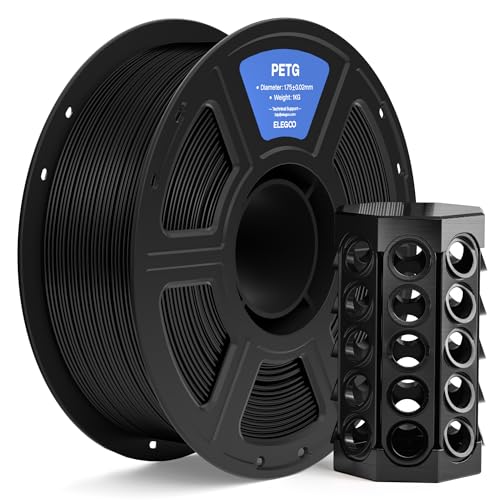
ELEGOO 1.75mm Black PETG Filament (1kg)
Best for: Functional black parts
- Material Type
- PETG
- Filament Diameter
- 1.75mm
- Net Weight
- 1KG
- Dimensional Accuracy
- +/- 0.02mm
- Printing Technology
- FDM
- Weight
- 2.2 pounds
View on Amazon: ELEGOO 1.75mm Black PETG Filament (1kg) Affiliate link
ELEGOO PETG black: 1kg 1.75mm at ±0.02mm, impact resistant, low warp, strong layer bonding, fits Neptune/Ender/Kobra; no temps or speed listed.
Pros
- Tougher than PLA
- No enclosure needed
- Tight tolerance
Cons
- No print settings listed
- Not a high-speed grade
Good fit if
- You print functional parts
- You run an open printer
Skip if
- You print at very high speed
Verdict: Dependable black PETG for everyday functional parts.
Specifications side by side
| Spec | ELEGOO 1.75mm Black PETG Filament (1kg) |
|---|---|
| Material Type | PETG |
| Filament Diameter | 1.75mm |
| Net Weight | 1KG |
| Dimensional Accuracy | +/- 0.02mm |
| Printing Technology | FDM |
| Compatible Material | PETG |
| Size | 1KG |
| Weight | 2.2 pounds |
| Color | Black 1kg |
Frequently asked questions
Is this ELEGOO Rapid PETG?
No. This is ELEGOO's standard PETG; the listing gives no high-speed rating.
What tolerance does ELEGOO list?
±0.02mm on 1.75mm.
Does it need an enclosure?
No; ELEGOO cites low warping and shrinkage.
Which printers does ELEGOO name?
Neptune, Ender, Adventurer and Kobra series, among most 1.75mm FDM printers.
ELEGOO PETG or PLA?
Choose PETG for clamps and parts that take knocks or warmth; choose PLA for detailed models and easier printing.
Featured in
See also
- elegoo silk pla shiny gold filament review
- elegoo rapid pla plus black white 2kg review
- elegoo pla cf black filament review
- elegoo pla filament review
- elegoo pla plus filament review
- ELEGOO Matte PLA Filament 1.75mm Review: Who It Fits and Who Should Skip It
- ELEGOO Rapid PETG Filament 1.75mm Review (2026): A Spec-Based Look
- ELEGOO Black ABS Filament 1.75mm 1kg Review (2026): A Spec-Based Look
- best ELEGOO 3d printers
- easycargo 30pcs 3d printer heatsink review