Bambu Lab Liquid Glue for Build Plate Review (2026)
As an Amazon Associate we earn from qualifying purchases. Links on this page are affiliate links.
Some Bambu Lab plates need a glue layer: the Cool Plate and High-Temperature Plate either hold prints poorly or bond too hard without one, and PETG on a bare smooth surface can pull flakes out of the coating. Bambu Lab's Liquid Glue (model Lgl001) is the maker's own adhesive for that job. Bambu Lab lists PLA, ABS and PETG and names the Cool Plate and High-Temperature Plate among the suitable surfaces. The listing names the P1P, P1S and X1C as compatible printers, though a glue works on any bed with a matching surface. Several bullets read like generic spare-part text (drop-in fit, OEM tolerances), and the page gives no volume in ml, only a 2.88 oz shipping weight. It is the safe pick if you want the glue Bambu Lab's own guides refer to. Details are from Bambu Lab's listing.
What stands out
- Bambu Lab's own plate glue
- For PLA, ABS and PETG
- Cool Plate and High-Temperature Plate
Who it fits
Good fit for
Bambu Lab owners printing on a Cool Plate or High-Temperature Plate, or PETG on a smooth surface, who want the official glue.
Who should skip it
Anyone who prints only on textured PEI without adhesion problems, and buyers who want a stated bottle volume.
Verdict: The official, low-risk glue for Bambu Lab plates; the listing itself is thin.
Bambu Lab Liquid Glue specs
Model Lgl001
Bambu Lab part code.
PLA, ABS, PETG
Listed materials.
Cool Plate, High-Temperature Plate
Named surfaces.
P1P, P1S, X1C
Listed printers.
Green
Listed color.
Volume
Not stated (2.88 oz shipping).
Adhesion and release
Glue does two things on a smooth plate. It helps the first layer stick, which matters for ABS corners that lift, and it acts as a release layer, so PETG comes off without tearing the plate's coating. That second job is the one many owners overlook. A thin, even layer is enough; thick glue leaves marks on the bottom of the print.
Using it
Spread a thin layer over the print area of a clean, cool plate, let it dry and print. Wash the plate with water when the layer builds up. Choose Bambu Lab's glue if you want the official product named in Bambu's guides; choose a third-party 60 ml liquid glue if you want a stated volume and a wider list of surfaces.
Before you order
Checks for Bambu Lab Liquid Glue.
Check before you buy
- You print on a smooth or Cool Plate
- You print PETG, ABS or large PLA parts
- You want Bambu Lab's own glue
- You do not need a stated ml volume
The product at a glance
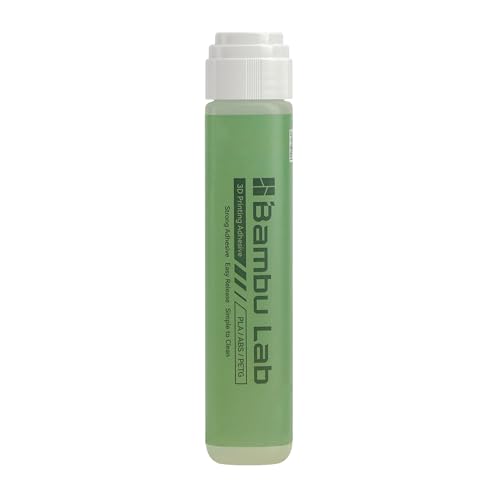
Bambu Lab Liquid Build Plate Adhesive
Best for: Bambu Lab smooth plates
- Compatible Material
- PLA, PETG, ABS
- Color
- Green
- Dimensions
- 5.55 × 1.22 × 1.14 inches
- Weight
- 2.88 ounces
View on Amazon: Bambu Lab Liquid Build Plate Adhesive Affiliate link
Bambu Lab Liquid Glue Lgl001: the official plate glue for PLA, ABS and PETG on Cool Plate and High-Temperature Plate surfaces.
Pros
- Official Bambu Lab product
- Helps adhesion and release
- Simple thin-layer use
Cons
- No volume stated
- Generic part text on the listing
Good fit if
- You print on smooth Bambu plates
- You print PETG
Skip if
- You only use textured PEI
Verdict: The low-risk choice for Bambu Lab plate glue.
Specifications side by side
| Spec | Bambu Lab Liquid Build Plate Adhesive |
|---|---|
| Compatible Material | PLA, PETG, ABS |
| Color | Green |
| Dimensions | 5.55 × 1.22 × 1.14 inches |
| Weight | 2.88 ounces |
| Model | Lgl001 |
Frequently asked questions
Which filaments is Bambu Lab Liquid Glue for?
PLA, ABS and PETG, according to Bambu Lab.
Which plates suit Bambu Lab Liquid Glue?
Bambu Lab names the Cool Plate and the High-Temperature Plate among others.
Which printers does Bambu Lab list for its liquid glue?
The P1P, P1S and X1C.
How much glue is in the Bambu Lab bottle?
The listing gives no ml volume, only a 2.88 oz shipping weight.
Why use Bambu Lab glue with PETG?
It acts as a release layer so PETG does not pull the plate's coating off.
Featured in
See also
- aladrs photon mono 4k screen protector review
- wefuit juupine smooth textured pei plate review
- wefuit 60ml liquid glue review
- best 3d printers under 200
- best 3d printers under 300
- Best 3D Printers Under $500 in 2026: 7 Picks Ranked by Specs
- Best 3D Printers Under $1000: 6 Spec-Based Picks
- 6 Best 3D Printers Under $1500, Compared
- bambulab bambu lab a1 fdm 3d printer review
- liquid force primo wakesurfer review